
Insights
4/15/26
.svg)
Has AI levelled the visualisation playing field?
Unpacking why an influx of flawless, high-speed rendering software makes conceptual intent and architectural responsibility more critical than ever.
Through Industry Voices, Trimble SketchUp partners with industry leaders to explore the shifts shaping the future of architecture and design. Here, architect, writer, and lecturer Shawn Adams presents a three-part series on digital transformation. Each standalone entry dives into a key pillar of modern practice—AI & Productivity, Digital Collaboration, and Visualization.
In this edition, architect, writer, and lecturer Shawn Adams shares his perspective on how AI is levelling the playing field in storytelling and visualisation, bringing together insights and reflections from leading voices across the industry. Follow the links at the end of each article to explore each part of the series.
Historically, hyper-polished visual presentations were a luxury brand separator exclusive to heavily resourced architecture firms. Today, instant rendering technology places that exact same graphical power into the hands of boutique operations and independent visual thinkers.
In the concluding instalment of his Industry Voices analysis, Shawn Adams uncovers a complex professional shift: as the barrier to visual execution drops, text prompt curation, intellectual rigour, and honest structural clarity become the ultimate differentiators.
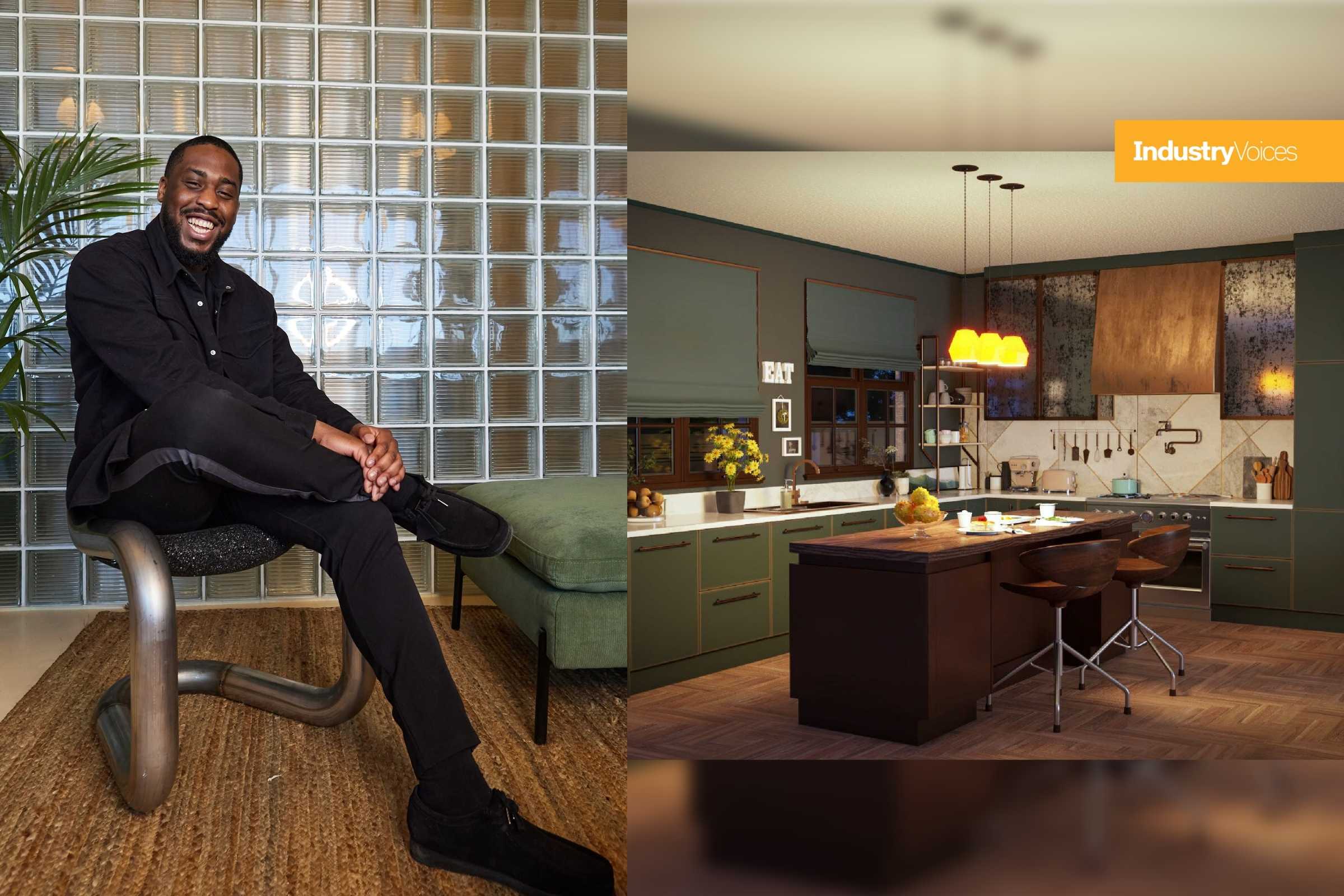

PART THREE BY SHAWN ADAMS
'I hope that Artificial Intelligence will mean that architects will have to pull fewer all-nighters,’ says AI and XR Product Manager at Trimble SketchUp, Aris Komninos. He says this jokingly, but the truth behind the comment is sobering. For decades, architects have pushed through exhaustion, navigating bloated workflows and an ever-growing stack of software.
One programme for 3D modelling, another for rendering, and countless forum threads for troubleshooting. For many designers, the creative process has often felt less about designing and more about overcoming software friction.
Much of this friction comes from design technology's long-standing reliance on add-ons. Need a specific rendering style? Install a plugin. Want to simulate daylight? Find the right extension.
And while platforms like SketchUp's Extension Warehouse are incredibly useful, having a single AI-driven workspace that learns as you design, renders in real time, and instantly troubleshoots issues would be transformative.
According to Komninos, this would dramatically enhance the design process, giving designers back valuable time. As he puts it, 'AI will empower design professionals by providing tools that streamline tedious tasks, accelerate analysis, and enhance overall productivity.'
Recent updates to SketchUp show this shift already taking shape. SketchUp's newly integrated AI Assistant can generate 3D objects and answer how-to questions via chat, while AI Render helps designers produce client-ready visuals quickly within the software.
3D objects can be created using both text and image prompts, saving designers significant manual modelling time. Meanwhile, SketchUp's AI Render tool (formerly known as Diffusion) allows users to generate photorealistic visuals through natural language prompts.
Traditional workflows are still available, but these new features greatly amplify design productivity, enabling users to quickly generate images and iterate on design ideas.
According to architect and founder of POC in Architecture, Savannah Williams, these advancements demonstrate how artificial intelligence is already becoming a meaningful asset within everyday design practice. 'AI has already proven a useful tool, assisting designers with shortening rendering time.'
She believes that embedded artificial intelligence in modelling software can help reduce rendering times, which is one of the most time-consuming aspects of visualisation work. By accelerating this process, designers can iterate more quickly, explore more options, and reach clarity sooner.
Williams emphasises that this technology streamlines early-stage experimentation without diminishing the role of the architect. 'It's a tool, not a replacement.'
AI in design software can facilitate faster cycles of trial and refinement. This, in turn, enables designers to test a far wider range of ideas in a single day.
For Williams, this shift makes the creative process more fluid, reducing the burden of repetitive tasks and providing more time for thoughtful, human-centred design decisions.
The founder of POC in Architecture notes that contemporary design already depends on a diverse ecosystem of software, with each tool supporting a different stage of the architectural workflow.
In her view, AI has the potential to streamline transitions between programmes and reduce duplicated efforts, ultimately enabling them to produce stronger work. However, she emphasises that AI will not replace third-party software.
Instead, she sees it as a complementary layer that enhances these tools through more seamless integration and smarter workflows.
While architecture has long been fuelled by sleepless nights, brutal deadlines, and mountains of digital admin, the rise of integrated AI tools hints at a quiet escape.
If artificial intelligence can streamline workflows, dissolve repetitive tasks, and let creativity take the lead, the design industry will move closer to what it has always meant to be. Not a test of endurance, but a discipline where time is used for thinking, imagining, and designing with intent.
AI will not just make architects work faster; it will give them back something far more valuable: time.