
Insights
10/8/25
.svg)
What is the future of digital collaboration?
Moving spatial dialogue away from isolated screenshots and into a single, real-time digital source of truth.
Through Industry Voices, Trimble SketchUp partners with industry leaders to explore the shifts shaping the future of architecture and design. Here, architect, writer, and lecturer Shawn Adams presents a three-part series on digital transformation. Each standalone entry dives into a key pillar of modern practice—AI & Productivity, Digital Collaboration, and Visualization.
In this edition, architect, writer, and lecturer Shawn Adams shares his perspective on the future of digital collaboration—bringing together insight and reflection from leading voices across the industry. Follow the links at the end of each article to explore each part of the series.
Architecture is rarely, if ever, executed in isolation. Yet the traditional mechanisms of remote design coordination—static slide decks, flat mark-ups, and fragmented email trails—constantly threaten the continuity of a great idea.
In this chapter of Industry Voices, Shawn Adams gathers perspectives from senior product technologists and boundary-pushing architects to examine the rise of multiplayer design mediums, unpacking why the soft skills of active human listening remain the absolute center of advanced 3D communication.
PART ONE BY SHAWN ADAMS
Collaboration is at the root of any good design,’ says Senior Project Manager at Trimble SketchUp, Gopal Shah. His words capture a truth every designer knows: great work emerges when people work together.
But what if ‘together’ no longer means being in the same room, or even the same continent, but inside the same digital space?
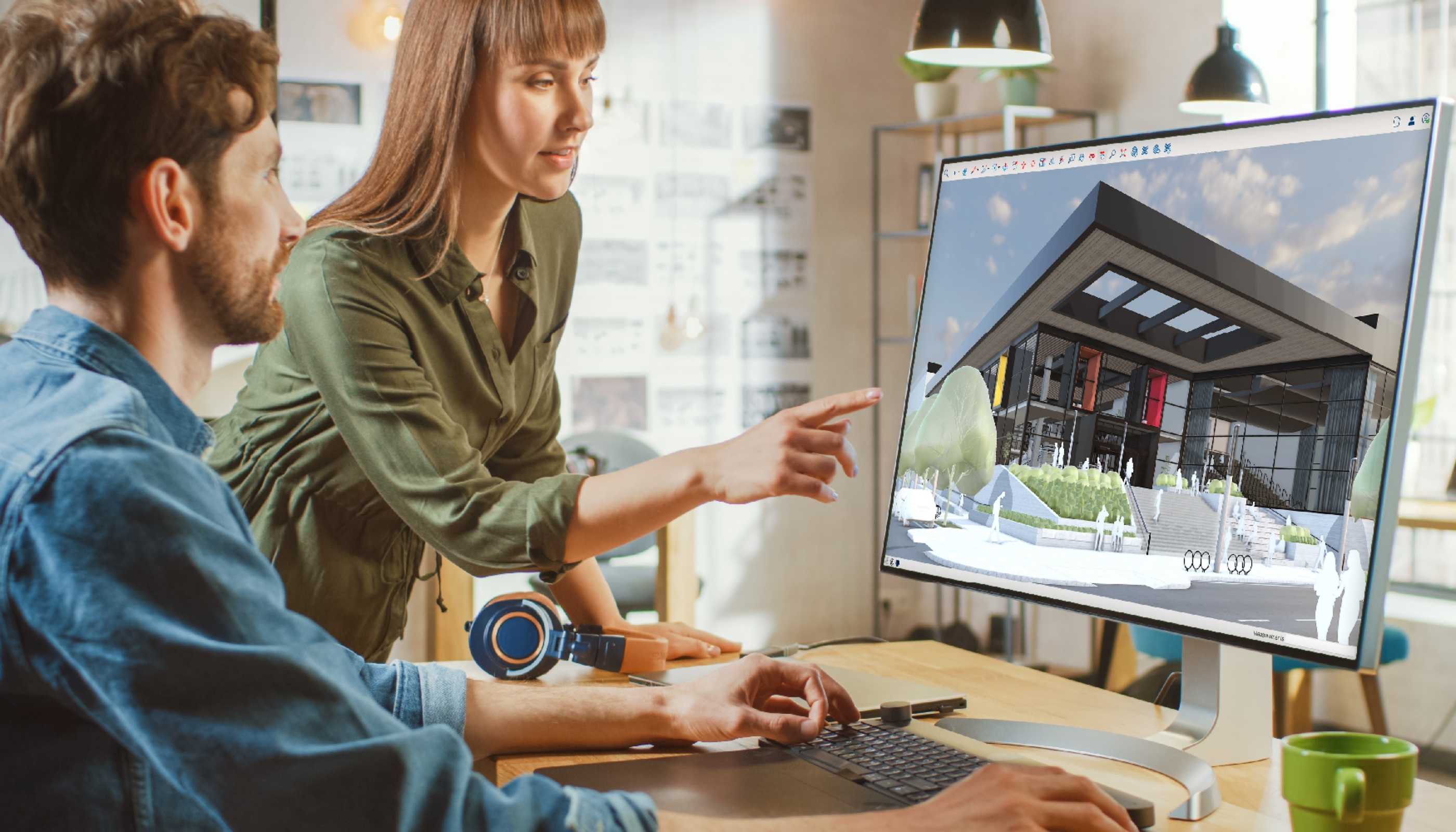
Picture a team orbiting a single 3D model in real time. One designer tweaks the geometry while another experiments with materials. Across the globe, a structural engineer in Tokyo highlights a tricky joint and tags it with a note, prompting an instant response from an architect in Paris.
Camera views are pinned directly to those comments, so everyone sees the issue from the exact same perspective. Gone are the days of juggling static screenshots and endless email chains. Instead, colleagues converse and iterate within the digital model space.
This vision is not science fiction but the near future. Software pioneers like Trimble SketchUp are already laying the groundwork for this
They are developing collaborative workflows, in-app commenting, and seamless cloud-based file sharing to enable the kind of fluid teamwork once reserved for in-person studios. ‘At SketchUp, we are trying to create tools that make it easier for people to work together,’ Shah says.
To move towards this, SketchUp first had to reimagine its platform. ‘We wanted to make SketchUp a multiplayer medium instead of a solo software that only one person can use at a time,’ explains Shah.
The result is a creative environment where design is not a solitary act but a shared experience. Currently, SketchUp offers impressive collaboration features such as in-app commenting, real-time viewing, and cursor and camera tracking so stakeholders can follow along during presentations and calls.
According to the Senior Product Manager, ‘Good software design is both familiar and new. It feels like something you can just pick up and use, but still allows you to do something you haven’t done before.’
A 3D model doesn’t run a project; people do. Successful digital collaboration depends as much on soft skills as on software.
Design teams must prioritise soft skills to make digital collaboration truly effective. Strong communication, active listening, empathy, and adaptability are essential for ensuring ideas are understood, while problem-solving and relationship-building foster trust and constructive conflict resolution.
Setting clear goals and maintaining consistent standards, like uniform naming conventions, are just as important as mastering any new technology.
Although innovative digital tools can streamline processes, no platform is better than its users. While the model provides the framework, it is the team’s soft skills that transform it into a dynamic, creative, and cohesive space.
While Mamou-Mani envisions a vibrant future for 3D software, he acknowledges that traditional methods still play a role. ‘Nothing can fully replace pen and paper, but if technology is made easy and fast, it will become a daily tool.
Shah echoes this perspective, stressing that digital tools are meant to augment, not override, established creative practices. ‘I don’t think these tools will replace what people are doing now but enhance their current setup,’ he says
The goal is not to erase the tactile joys of sketching by hand or building physical models, but to integrate those practices into a more connected workflow. ‘Experience and a critical mindset will be vital in the future. These are skills that go way beyond the 3D model,’ adds Mamou-Mani.
Looking ahead, Mamou-Mani predicts, ‘In the future, it will be incredibly fast to visualise, test, and modify 3D models.’
Whether through speech, sketches, or text, every message must be precise and inclusive so that all participants share the same understanding. As Shah notes, ‘Whenever it’s convenient, people can jump into the model, update it, then pass it on to someone else.’ That fluidity only works when team members have strong communication skills.
Over time, the 3D model will act as a shared studio where dialogue is integral to the design process. Every discussion remains tied to the geometry, ensuring decisions are made in context and with clarity.
Instead of treating dialogue as an afterthought, the model itself will become the centre of the conversation, a single source of truth. ‘Success in the future will depend on asking good questions and understanding how things work,’ says Mamou-Mani.
‘Having a model to verify information is invaluable, especially with today’s increasingly complex projects,’ says Mamou-Mani. ‘The more eyes on something, the easier it is to spot discrepancies,’ he notes.
As cloud platforms grow faster and more robust, real-time 3D collaboration will become smoother and more natural. High-fidelity visualisation, AI-driven insights, and powerful version control will also support a process that feels as immediate and engaging as working together in person.
Ultimately, good design will always be a human endeavour shaped by conversation, iteration, and shared insight. No matter how advanced 3D modelling technology becomes, the heart of the creative process remains rooted in people: their ability to listen, interpret, question, and respond.
As Shah states, ‘no one builds a building alone.’ The most powerful tools are not those that automate design, but those that enable teams to think more clearly, communicate more effectively, and collaborate more meaningfully.
Soon, stepping into a 3D model will feel like walking into a borderless workspace, where designers, engineers, and stakeholders work collectively. We may not be quite there yet, but this is the future.
This isn’t just a technological shift; it’s a cultural one. It redefines what it means to work ‘together’. In this new landscape, success will belong to those who can navigate both the digital and human dimensions of design, those who combine technical fluency with good communication.
After all, if a picture is worth a thousand words, how much is a 3D model?